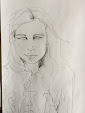
Paganini
,
1819. Pencil drawing, 12 x 8 1/2 in. Louvre, Paris Princess de Broglie
,
1853. Oil on canvas, 47 x 35 in. Metropolitan Museum of Art, NYC.
Ingres: (pronounced 'Ang') 1780-1867. French painter, a student of David and leading exponent of the Neo-Classical style. He studied and worked in Rome about 1807-20, where he began the Odalisque series of sensuous female nudes, then went to Florence, and returned to France 1824. His portraits painted in the 1840's-50's are meticulously detailed and highly polished.
Ingre's style developed in opposition to Romanticism. Early works include portraits of Napoleon. Later he painted huge ceilings for the Louvre and for Autun Cathedral. (Brockhampton)


 Daumier (1808-79). French caricaturist, painter and sculptor. During his lifetime he was known chiefly as a political and social satirist, but since his death he has been increasingly recognized as a painter. In 1830, after learning the still fairly new process of lithography, he began to contribute political cartoons to the newly launched anti-monarchist weekly, La Caricature. It's said he produced more than 4,000 lithographs, wishing at the time that the one he had just made could be his last. His paintings were probably done for the most part fairly late in his career. As a caricaturist Daumier stands above all others of the 19th century. The essence of his satire lay in his power to interpret mental states in terms of physical absurdity, but in his directness of vision and lack of sentimentality he has affinities with the realism of Courbet. Although he never mad a commercial success of his art, he was appreciated by the discriminating, his friends and admirers including Baudelaire, Degas, Delacroix, and Forain. In his final years he was almost blind and was saved from destitution by Corot. (Ian Chilvers)