Showing posts with label Abstract Art. Show all posts

Wednesday, December 10, 2008

Notes to Myself... Richard Diebenkorn

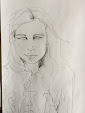
Self-portrait - no date. Sketchbook sheet, private collection.
Urbana No. 6, 1953. Modern Art Museum of Fort Worth, TX

Cityscape I, 1963. MOMA - San Francisco.

Girl with Flowered Background, 1962

Urban No. 4, 1953.

Coat I, III, IV, V, 1990. Etchings, private collection.
Notes to myself on beginning a painting...
1. Attempt what is not certain. Certainty may or may not come later. It may then be a valuable delusion.
2. The pretty, initial position which falls short of completeness is not to b valued - except as a stimulus for further moves.
3. Do search. But in order to find other than what is searched for.
4. Use and respond to the initial fresh qualities but consider them absolutely expendable.
5. Don't 'discover' a subject - of any kind.
6. Somehow don't be bored - but if you must, use it in action. Use its destructive potential.
7. Mistakes can't be erased but they move you from your present position.
8. Keep thinking about Polyanna.
9. Tolerate chaos.
10. Be careful only in a perverse way.
From the Art of Richard Diebenkorn by Jane Livingston. Published by Whitney Museum of American Art, NY.

Monday, December 8, 2008

Albert Swinden

Flower Still Life in Browns and Red, 1940. Gouache on paper, 13 x 16 ". From the estate of the artist. Available through Childs gallery of Boston.

Born in Birmingham, England, Albert Swinden moved to Chicago at the age of 18 to study at the Art Institute. In the mid-1920s, he moved to New York where he studied at the National Academy of Design and the Art Students League of NY. He was a student of famed Abstract Expressionist artist Hans Hofmann and as a result, developed a strong interest in Synthetic Cubism and Neoplasticism, a movement made popular in the 1910s by artist Piet Mondrian. Typically recognized for his abstract style, he was the founder of American Abstract Artists. (from American Art Review magazine, December, 2008)

Thursday, November 13, 2008

Dark Abstraction

Dark Abstraction, 1924. Oil on canvas, 25 x 21 in.

It is surprising to me to see how many people separate the objective from the abstract. Objective painting is not good painting unless it is good in the abstract sense. A hill or tree cannot make a good painting just because it is a hill or a tree. It is lines and colors put together so that they say something. For me that is the very basis of painting. The abstraction is often the most definite form of the intangible thing in myself that I can only clarify in paint.
-Georgia O'Keeffe

Sunday, July 20, 2008

Op Art

Current, Bridget Riley, 1964. Synthetic polymer paint on composition board, 58 x 58". MOMA, New York.

An abbreviation of 'optical art', a form of abstract art which developed in the early 1960s and aimed at stimulation of the eye through a radical use of space and color. This was achieved by the employment of hard-edged, flatly painted shapes in black and white or in complementary colors of full intensity. The term 'Op art' was first used in Time magazine in 1964 and had become a household phrase by the following year when the defining exhibition The Responsive Eye was held at the MOMA, NYC. Two of the most prominent Op artists were Bridget Riley and Victor Vasarely. Op art exerted a considerable influence on women's fashion in the mid-1960s. (Michael Clarke)
**sorry about the fuzzy photograph!**