Monday, January 31, 2011

Bestiaries

Master Ermengaut, November, Acorn Harvest. Escorial, Monastery of San Lorenzo, Library.


A bestiary is a scientific and educational collection of writings about animals. Bestiaries were very fashionable in the West. Thanks to them, the naturalistic knowledge from antiquity was disseminated. The bestiaries were primarily used as collections of exempla, which were referred to during sermons. As the same time they reflect those elements of the fantastic and the supernatural in the early medieval imagination, which had first appeared in the so-called libri monstruorum during the early Middle Ages. The animals which occur so often in medieval art are derived from a variety of sources and traditions - in the bible alone nearly one hundred and fifty animals are mentioned. These may have derived partly from the bestiaries, but are ultimately all related to the same cultural heritage. (Riccardo Belcari and Giulia Marrucchi)

Monday, June 7, 2010

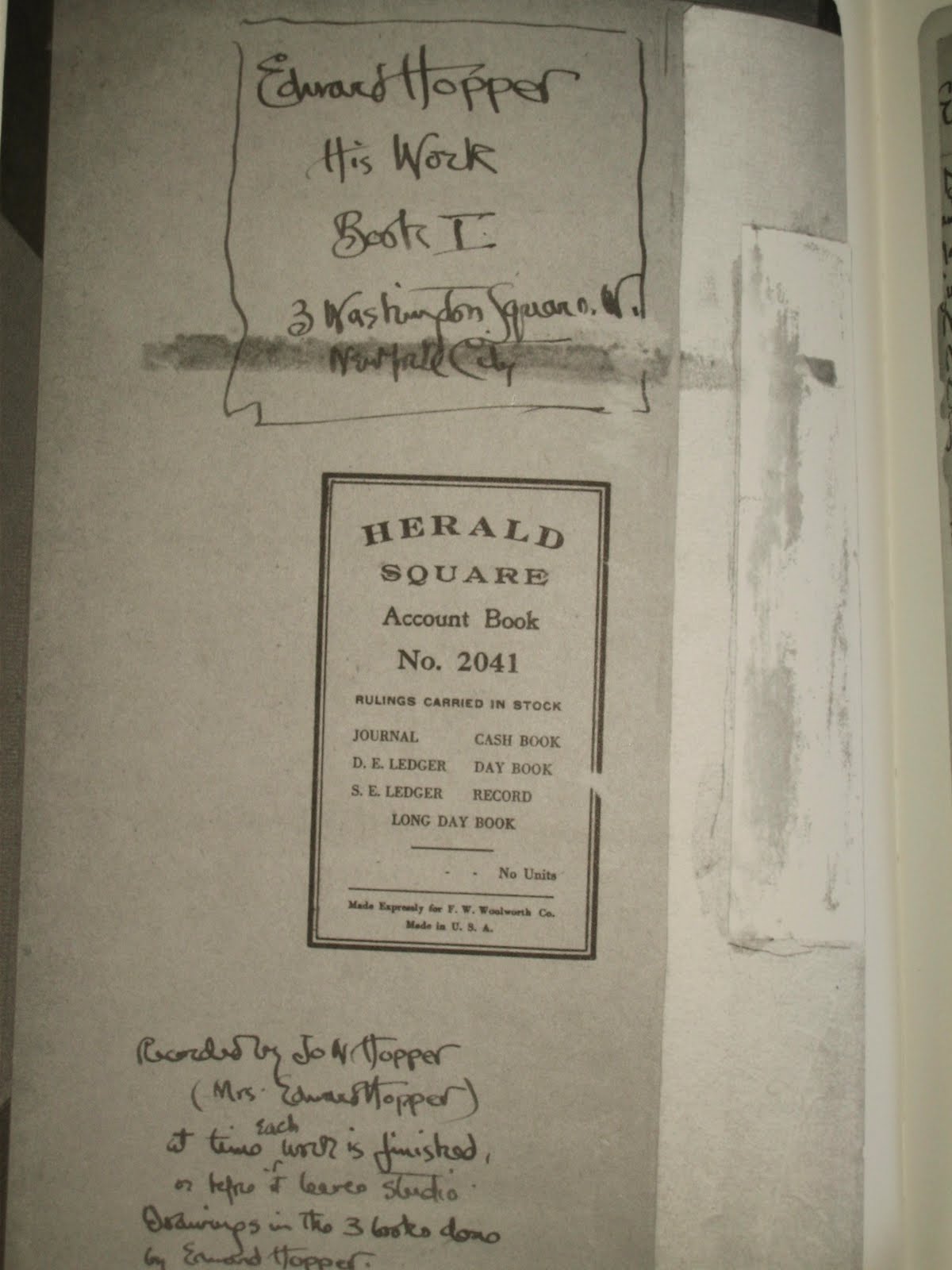
A Smidge of Hopper's Ledger


Few documents testify so insistently to an intimate relationship between a husband and wife as the Hopper ledgers. They present another aspect of the marriage of Edward Hopper and Josephine Nivison Hopper, a marriage on its way to becoming legendary. Edward Hopper died in 1967, his wife the following year. She bequeathed to the Whitney Museum a trove of paintings (including her own), documents, drawings, and memorabilia. In ten months of her widowhood, she edited the surviving material, which after her death may have suffered further losses before it found its permanent home. A generous woman, she acknowledged the long-term support of the Whitney's their direction, Lloyd Goodrich, by leaving him the four ledgers, which record in detail almost every painting and etching made, exhibited, and sold throughout Edward Hopper's long career. (Brian O'Doherty)
From the Book, Edward Hopper: A Journal of His Work. Deborah Lyons. 1997, Whitney Museum of American Art.


Thursday, June 3, 2010

William Blake


When the Morning Stars Sang Together (1823) - William Blake.

William Blake (1757-1827) was a gifted engraver... here is one of my favorite pieces.
Blake invented a method of relief printing from metal plates, and ways of obtaining many colors simultaneously that only recently has been equalled.
This particular plate has been selected as one of the best of Blake. "When the morning stars sang together," one page from The Book of Job illustrated by Blake, reveals the sweep of his admittedly complex and obscure but wedded to the realities of his time - a breadth of vision moving beyond the theme of conflict between Good and Evil. (Jules Heller)

Friday, May 21, 2010

Illustration, 1902. From a Novissima annual, Milan 1902. Lithograph, 12 x 26 cm.

Antonio Rizzi
Born 1869 in Cremona Italy, Died 1941, Florence.
Italian painter and graphic artist. Rizzi was professor of graphic art at the Academy in Perugia and a contributor to the Munich periodical Jugend. His work has a general resemblance to Munich Art Nouveau, in particular the work of Franz von Stuck. As a painter, he produced historical and genre paintings, portraits and sets. (Gabriele Fahr-Becker)

Tuesday, May 4, 2010

Asphaltum

Applying the asphaltum to the matrix.

Asphaltum: A stop-out varnish employed in the intaglio process when long bites are required. Usually mixed with turpentine or benzine for better control. Also one of the ingredients in hard ground. Also employed in lithography by some printmakers in preference to tusche. Called bitumen in older texts. (Jules Heller)

Friday, April 23, 2010

Coming Soon...

Hall of Doges, Davenport Hotel, Spokane.

I'm planning a comeback! Starting next week, I will attempt to post at least 2 to 3 times a week. It's been too long away from art history and I'm excited to bring some fun stuff from the bookshelves :)

Thursday, January 28, 2010

Alice Schille

Horse Race, Siena, 1901-10. Watercolor, 9 x 11". Courtesy Perry Nicole Fine Art, Memphis, Tennessee.
Trafalgar Square, London (night), 1909-10. Pastel and watercolor, 12 x 9". Private collection
Nice, 1909-10. Pastel and Watercolor. 10 x 7". Private collection
Alice Schille (1869-1955) was born in Columbus Ohio, and studied in New York and Paris and was influenced by progressive art movements. She was a world traveller, painting throughout the US, Europe, North Africa and Latin America. Her medium of choice was watercolor but she also worked in oils. Her subject matter included still lifes, landscapes, gardens, mothers and children, market and harbor scenes. Her paintings of the working class Jewish and Italian neighborhoods on the Lower East Side are some of the most exciting watercolors ever rendered of urban life in New York.
Schille's work evolved from Tonalist naturalism, through Impressionism and Post-Impressionism (including Pointillism) to include the influence of Fauvism as well as an exploration of the faceting of the Cubist methodology. Her later work also reveals the influence of Rivera and the Mexican muralists. (William H. Gerdts)

Saturday, January 23, 2010

Letter O


O has been written the same way since early Semitic times, but since there were no vowels in the written language, this form signified a guttural "C" sound, from the word cayin (eye). The Greeks assigned it the "O" sound. (Rose Folsom)

Monday, January 11, 2010

A Difficult Indigo...

Around 1878, Emil Fischer* and his brother determined the structure of fuchsin, (a cherry-red dye) and were then able to develop a scientific method of synthesizing it. This procedure was used by many chemists who were trying to create new synthetic colors. The biggest challenge was to synthesize the 'king of colorants', indigo. By 1880, a German chemist, Adolf von Baeyer completed the synthesis of indigo in his lab, but couldn't find a synthesis that was cost-effective on an industrial level. After 20 years and 20 million marks spent, he succeeded. In 1904, Germany exported 9,000 tons of synthetic indigo, and 3 times as much in 1913. Whole regions were ruined - in India and the Caribbean; the English indigo trade disappeared and the shipping trade of Marseilles, wholly dependent upon it, also collapsed. (Delamare and Guineau)

*Emil Fischer - Organic chemist (1852-1919) devoted to the graphic representation of molecular structures, study of the major types of organic chemical reactions,and the study of colorants.

Tuesday, November 24, 2009

Honore Daumier


Daumier (1808-79). French caricaturist, painter and sculptor. During his lifetime he was known chiefly as a political and social satirist, but since his death he has been increasingly recognized as a painter. In 1830, after learning the still fairly new process of lithography, he began to contribute political cartoons to the newly launched anti-monarchist weekly, La Caricature. It's said he produced more than 4,000 lithographs, wishing at the time that the one he had just made could be his last. His paintings were probably done for the most part fairly late in his career. As a caricaturist Daumier stands above all others of the 19th century. The essence of his satire lay in his power to interpret mental states in terms of physical absurdity, but in his directness of vision and lack of sentimentality he has affinities with the realism of Courbet. Although he never mad a commercial success of his art, he was appreciated by the discriminating, his friends and admirers including Baudelaire, Degas, Delacroix, and Forain. In his final years he was almost blind and was saved from destitution by Corot. (Ian Chilvers)

Sunday, November 15, 2009

Susan Rothenberg

Maggie's Cartwheel 1981-82. Oil on canvas, 25 x 30"
Mondrian Dancing 1984-85. Oil on canvas, 78 x 91"

Pontiac 1979. Acrylic and flashe on canvas. 88 x 61"

"Some of the pictures are truly mysterious to me... which is why I so often say publicly that I don't know or don't care what they're really about. And yet I can say that the paintings are prayers... that they have to do with whatever it is that makes you want more than what daily life affords." - Susan Rothenberg.

Tuesday, November 10, 2009

"The Only Rule is Work " - Corita


One of my all time favorite artists, Sister Corita Kent (1918-1986) made up this list of rules for the art college in which she worked. No. 7 is the best rule ever... it's my mantra!
'Admired by Charles and Ray Eames, Buckminster Fuller and Saul Bass, Sister Corita was one of the most innovative and unusual pop artists of the 1960s, battling the political and religious establishments, revolutionizing graphic design and encouraging the creativity of thousands of people - all while living and practicing as a Catholic nun in California.

Mixing advertising slogans and poetry in her prints and commandeering nuns and students to help make ambitions installations, processions and banners, Sister Corita's work is now recognized as some of the most striking - and joyful- American art of the 60s. But, at the end of the decade and at the height of her fame and prodigious work rate, she let the convent where she had spent her adult life. '
- (Julie Ault.)
**From the book, Come Alive! The Spirited Art of Sister Corita by Julie Ault. Published by Four Corners Books, 2006.

Wednesday, July 22, 2009

To Clam Island

Just a note to say hello and hope you all are enjoying summer! Our boat has set sail and I probably won't be back blogging more regularly 'til school starts. Until then, enjoy and see you soon :)
This painting is acrylic on canvas... by me. It's at one of my favorite 'secret beaches' in my hometown.

Thursday, July 2, 2009

Konrad Witz

Konrad Witz, The Miraculous Drought of Fish, from the Altarpiece of St. Peter, 1444. Tempera on wood, approx 51"x61". Musee d'Art et d'Histoire, Geneva.

German-born Swiss painter whose sharply observed realism suggests that he was familiar with the work of contemporary Flemish artist such as Jan van Eyck. Lake Geneva is the setting for a biblical story in his best-known work, The Miraculous Drought of Fishes 1444, representing one of the earliest recognizable landscapes in European art. (Brockhampton)


Monday, June 22, 2009

The Storm is Coming

Woodcut by Antonio Frasconi. Emigrated from Uruguay, Frasconi is a master graphic and woodcut artist. He's one of my personal faves... I did a previous post (December 2008) with some of his Christmas and winter scenes.
"Coupled with technical virtuosity is a rich, meaningful content. Frasconi has taken the popular art of the woodcut and clothed it in visually exciting color. " (sorry there were only black and white photographs available!) (Jules Heller)

Monday, June 8, 2009

Scratchboard


Scratchboard is a lovely way to draw and it looks a lot like an etching or wood engraving but is much easier. It only requires the scratchboard and a few scratching knifes and tools. It is available on a panel or thick, rigid bristol board like paper. It's made by coating paper or board with a thin layer of clay and a layer of India ink on the surface. After scratching out the image, it can be colored or painted. Cool stuff!

Images from an enchanting children's book called The House in the Night by Susan Marie Swanson. Pictures by Beth Krommes. (Houghton Mifflin Co. 2008)
PS. I've been experiencing a family crisis which is why I haven't been posting on this blog much in the past few months... it's a bit time consuming to post because I do research things. Please bear with me. I love sharing art history with you all and have greatly enjoyed and appreciate your comments and visits. (I've no intention of shutting down Artslice.) Hopefully things will improve and I can get back on track.

Wednesday, June 3, 2009

V

V had been, in early roman Times, both vowel and consonant. Its vowel value was eventually supplanted by 'U' and 'W.' As a Roman numeral it stands for 5, variously explained as half of 'X' (10) or five fingers of the hand held in a 'V' shape. (Rose Folsum)

Monday, June 1, 2009

Lucien Pissarro

Femme au bois, 1891
Gardeuse d'Oies, 1923

Liseuse, 1891


from The Queen of the Fishes, 1894

Born in Paris in 1863, died in 1944 in Epping, England. Lucien Pissarro was the son of painter, Camille Pissarro. He grew up surrounded by his father's great artist friends: Gauguin, Seurat, Signac and Felix Feneon. As a young man Lucien was inspired by the work of Kate Greenaway; one can see the influence in his designs and illustrations of children's stories. In 1886 Lucien exhibited his paintings, drawings, and prints in the 8th and final Impressionist Exhibition, then turned almost exclusively to making prints. Soon after, he moved to England permanently.
Lucien arrived in London just as the Arts and Crafts movement was gaining momentum. William Morris had just established his Kelmscott Press. Lucien saw the opportunity to combine his love of book making and illustration and founded the Eragny Press. It ran for 20 years from 1894-1914 and published 32 titles (including works of Flaubert, Francis Bacon, Christina Rossetti and Keats) with more than 300 wood-engraved illustrations, borders, and fancy capitals. The press closed when WWI broke out but its legacy is a beautiful combination of the French Impressionistic interest in color and light and the English aesthetic of Arts and Crafts design. (Lora Urbanelli)

**from The Book Art of Lucien Pissarro by Lora Urbanelli, 1997. Published by Moyer Bell.

Friday, May 15, 2009

Vintage Advertising

1920's.
1930's

1950's
Just for fun, check out these old Cigarette Advertisements... with the Doctors smoking! These range from the 1920's , 30's (these are the first 2 images and are illustrated). The late 40's-early 1950's have photography in them.
Sorry for the blur today!

Wednesday, May 13, 2009

'F'

F from early Greek times until about 200BC this sign looked something like a backward "F." and had the wound of a modern "W." The Latins gave it the form and phonetic value that we use today. (Rose Folsum)